A Framework for Systematic Reversal Trading
Most traders lose money attempting to 'catch falling knives' or 'call market tops' because they approach reversals with guesswork and emotion. Successful reversal trading is not about predicting or anticipating a move; it is about confirmation and methodology. It requires a systematic approach that combines precise technical signals with a disciplined psychological framework to identify high-probability turning points in counter-trend trading.
This guide outlines a framework for trading reversals-a method focused on three core components: oscillator divergence, trendline break confirmation, and session timing. This is not a theoretical exercise; it is a practical guide to building a systematic methodology.
The Foundation: Separating Pullbacks from Reversal Setups
The most common mistake in counter-trend trading is confusing a low-probability pause with a high-probability reversal setup. This distinction determines whether an entry is based on a valid, tradable move or is simply fighting a trend that is taking a brief rest.
Pullbacks (Market Noise): These are temporary pauses that offer poor risk-reward for counter-trend traders. They typically occur on declining volume and maintain the immediate market structure (e.g., higher lows in a 5-minute uptrend). A systematic approach aims to ignore these.
Reversal Setups (Tradable Opportunities): These setups actively break the immediate market structure and indicate a tradable shift in momentum. They are confirmed by a break of key short-term levels (e.g., a lower low in a 5-minute uptrend) and often occur with a surge in volume.
A systematic approach is designed to filter out the noise of minor pullbacks and focus only on confirmed signals that offer a high-probability counter-trend opportunity.
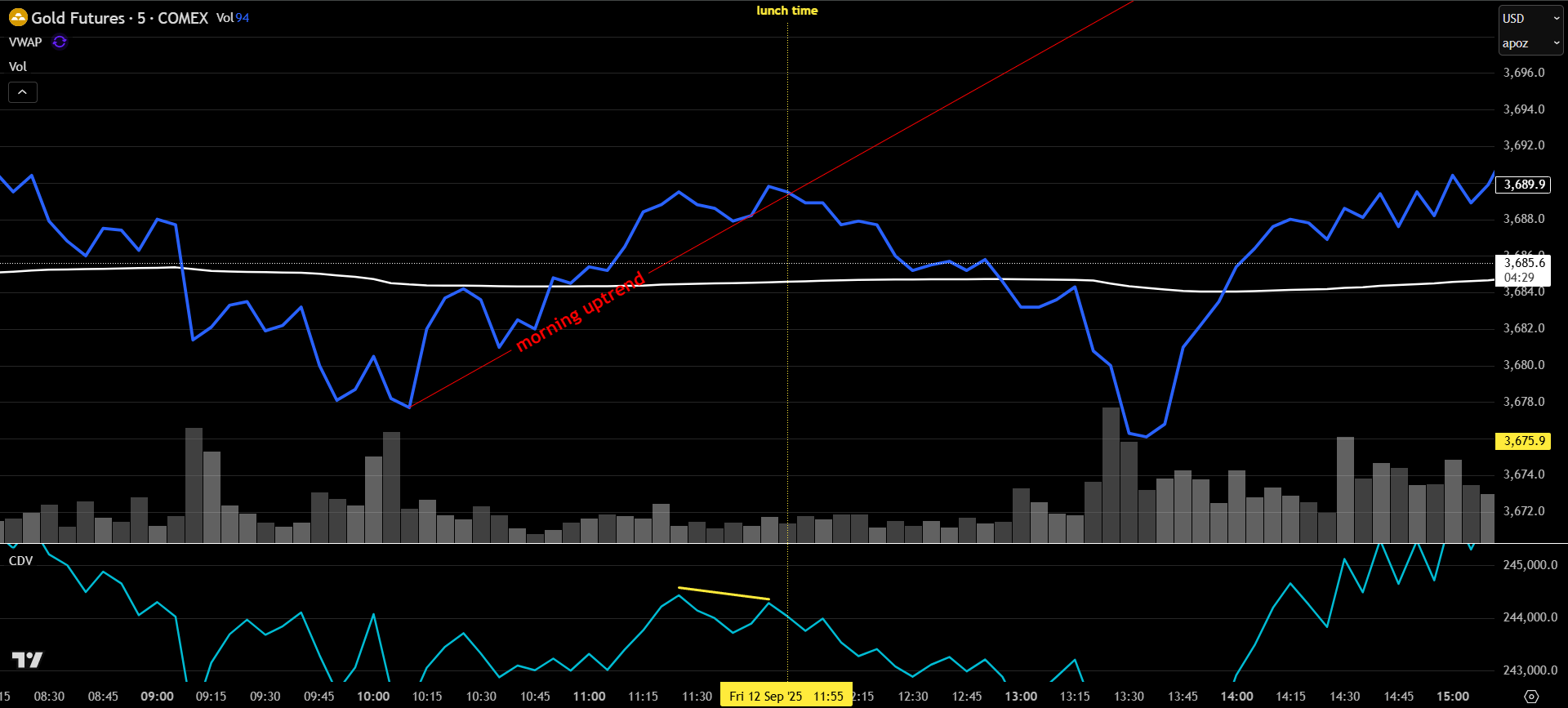
Gold futures 5 minute reversal at lunch time after morning uptrend
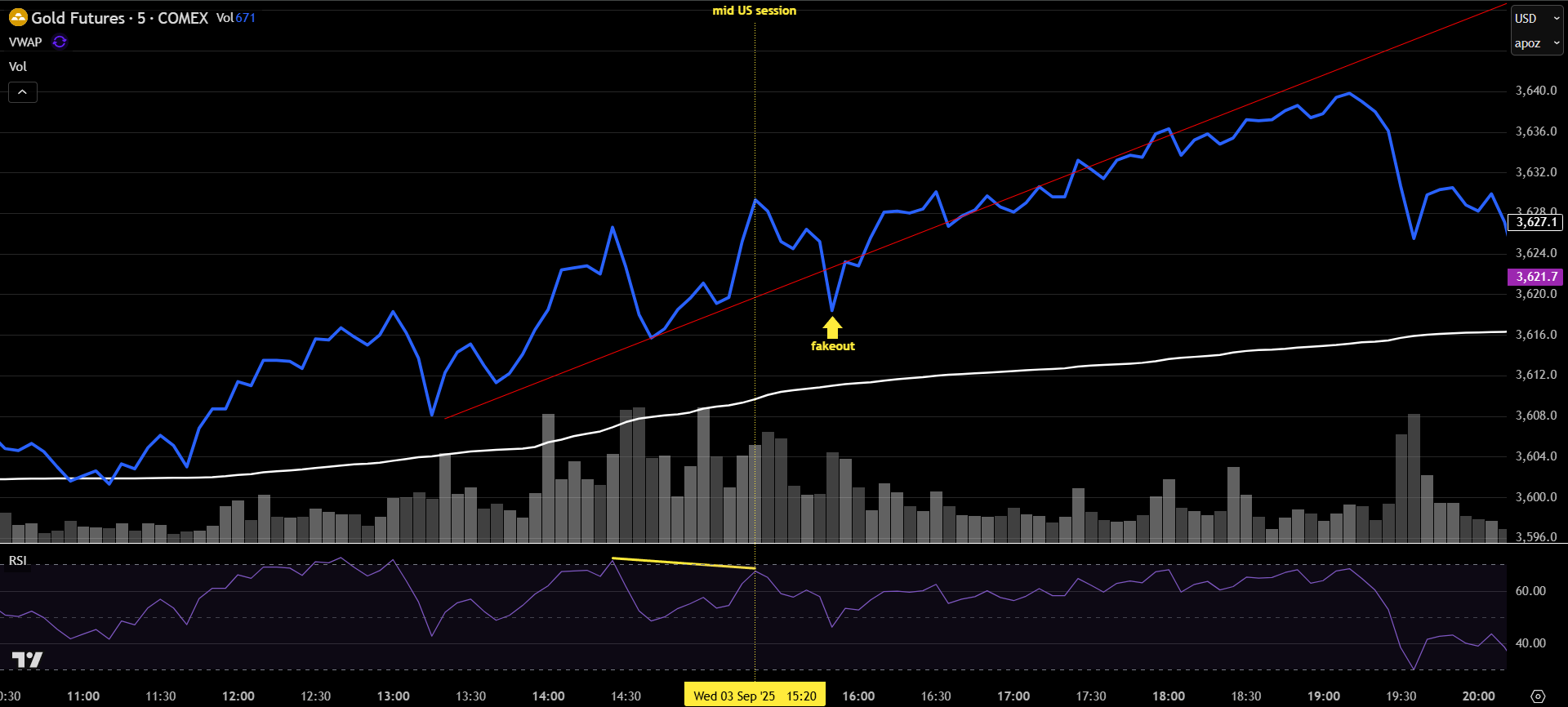
Gold fake out mid US session with RSI divergence
Core Methodology: The Divergence + Trendline Break System
A disciplined technical approach can be built on a two-step process. The principle is not to predict, but to wait for the market to produce a high-quality signal and then wait for confirmation.
Step 1: Identify High-Quality Divergence
Divergence can be a primary signal for a potential reversal. It occurs when price makes a new high or low, but the underlying buying or selling pressure fails to confirm the move. An excellent tool for measuring this is the Cumulative Delta Volume (CDV) indicator.
CDV tracks the net difference between aggressive buyers and sellers in the market. A divergence with CDV signals that even though the price is pushing to a new extreme, the conviction behind that move is fading. This indicates that the current trend may be losing momentum.
- Bearish Divergence: Price makes a higher high, but CDV makes a lower high (showing less aggressive buying).
- Bullish Divergence: Price makes a lower low, but CDV makes a higher low (showing less aggressive selling).
Quality is critical. A systematic trader considers only clear, obvious divergence signals. Marginal or "hidden" divergences are treated as market noise and are ignored.
Step 2: Wait for Trendline Break Confirmation
A divergence signal alone is not enough to justify a trade. It is only an alert that a reversal is possible. The entry trigger should be a clean break of the trendline that defines the most recent price swing.
For a bearish divergence (at a top): Draw a trendline connecting the recent lows. The trade is triggered when price breaks cleanly below this line.
For a bullish divergence (at a bottom): Draw a trendline connecting the recent highs. The trade is triggered when price breaks cleanly above this line.
This confirmation step helps prevent entering too early and acts as evidence that the market structure is actually beginning to shift.
To see a detailed breakdown of this divergence and trendline break methodology on a live trade, read our systematic Copper trade case study.
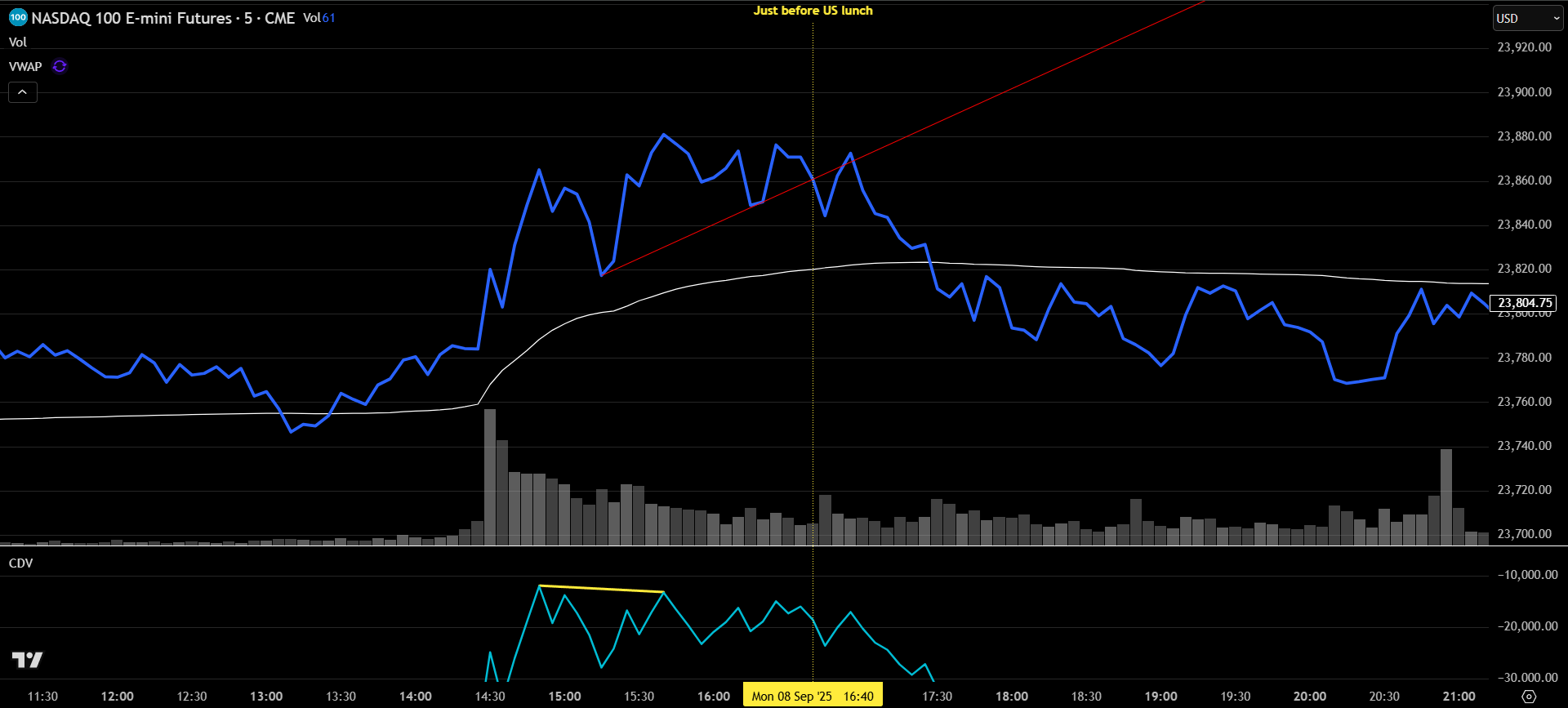
NQ 5 minute reversal just before US lunchtime
The Master Filter: Why Session Timing is Everything
A perfect technical setup at the wrong time is a trap. Experience shows that even the clearest divergence signal will likely fail if it occurs during a low-probability period. Timing is the ultimate filter for a systematic reversal approach.
High-Probability Reversal Windows
These are specific, limited windows where reversals have a statistically higher chance of success due to institutional activity and market structure.
The London Open (8:00 - 9:30 London time): The first 1.5 hours after the open brings fresh liquidity and a reassessment of the overnight trend, creating clear opportunities.
The London Lunch (approx. 11:30 - 12:30 London time): As morning momentum exhausts, this period often provides high-probability setups for reversals against the established session trend.
The US Pre-Lunch (11:30 - 12:00 ET): Similar to the London Lunch, this window often sees the exhaustion of morning momentum in the New York session.
The Mid-Session Trap (The Danger Zone)
The periods between these windows are low-probability zones. For example, attempting to fade a strong trend between 9:30 AM and 11:30 AM London time is a common mistake. Signals that appear during these times are often "fake-outs" that trap counter-trend traders before the original trend resumes.
Discipline in a systematic approach means waiting for a valid setup to appear within a high-probability time window. A trader must have the patience to ignore even the most tempting signals that appear outside of these specific times.
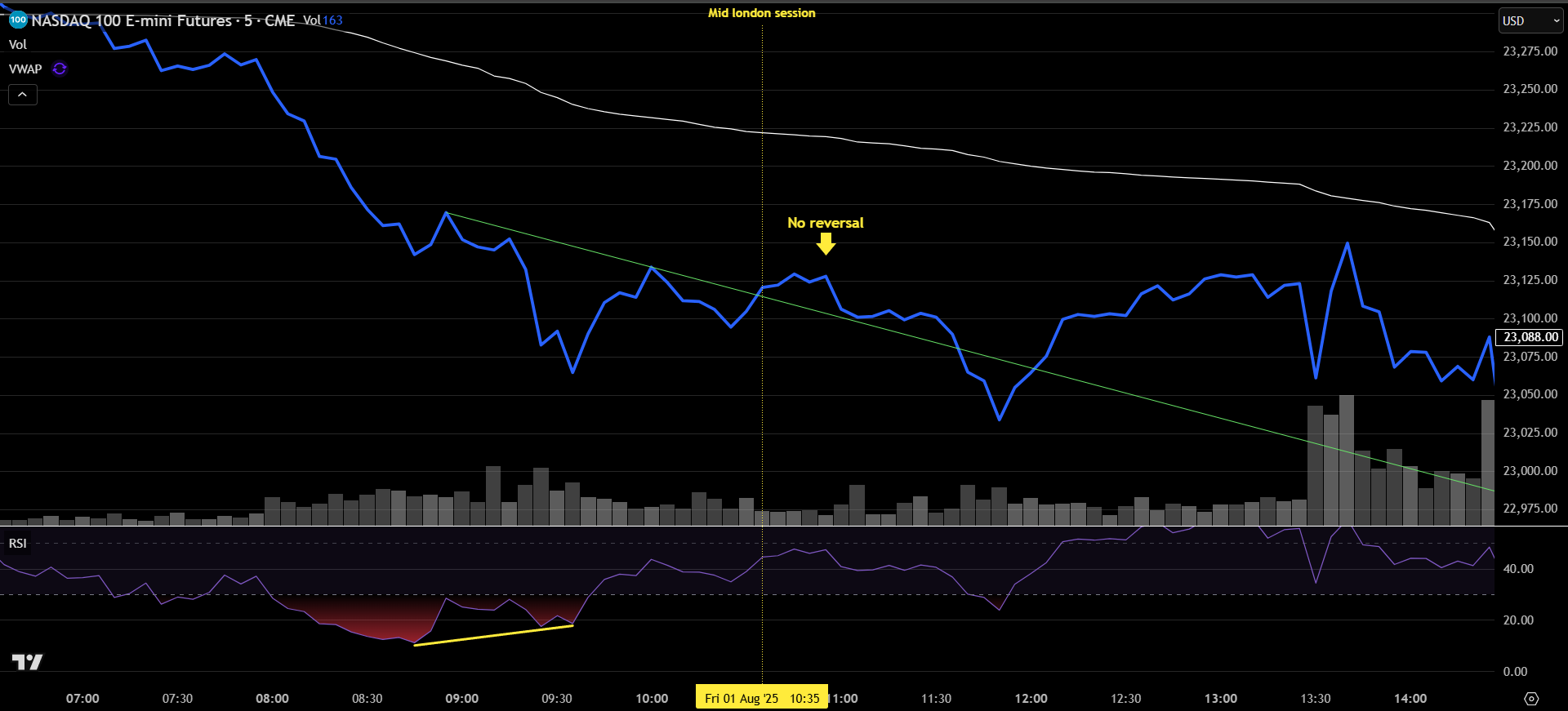
NQ failed reversal with bullish divergence mid London session
The Psychology of Reversal Trading: The TILT Framework
Technical signals are ineffective without the psychological discipline to execute them. Reversal trading is inherently contrarian, which demands a robust mental framework. The TILT framework can be integrated to manage the unique pressures of this style.
Executing the Noble Loss: A trade that hits its pre-defined stop-loss is not a failure. When a divergence setup fails and the stop is hit, it can be framed as a "Noble Loss": a successful execution of the plan that preserved capital for the next opportunity.
Avoiding the Success Trap: After a winning trade, it is easy to become overconfident and deviate from a proven system. The "Success Trap" is the tendency to take a lower-quality setup because of recent success. A rigid, systematic checklist provides the discipline to prevent this.
The Contrarian Mindset: Buying when everyone is selling and selling when everyone is buying feels unnatural. A solid framework provides the conviction to act on a valid signal, even when it goes against the herd.
Conclusion: The Systematic Advantage
Successful reversal trading does not come from a mystical art of prediction. It comes from the consistent application of a positive-expectancy system. By focusing on a specific combination of high-quality divergence, trendline confirmation, and optimal session timing, a trader can replace guesswork with a high-probability methodology.
This systematic approach, combined with a disciplined psychological framework like TILT, provides the consistency necessary for long-term success in contrarian trading.